When Compliance and Instruction Live in Separate Lanes: A Leadership Imperative for Special Education
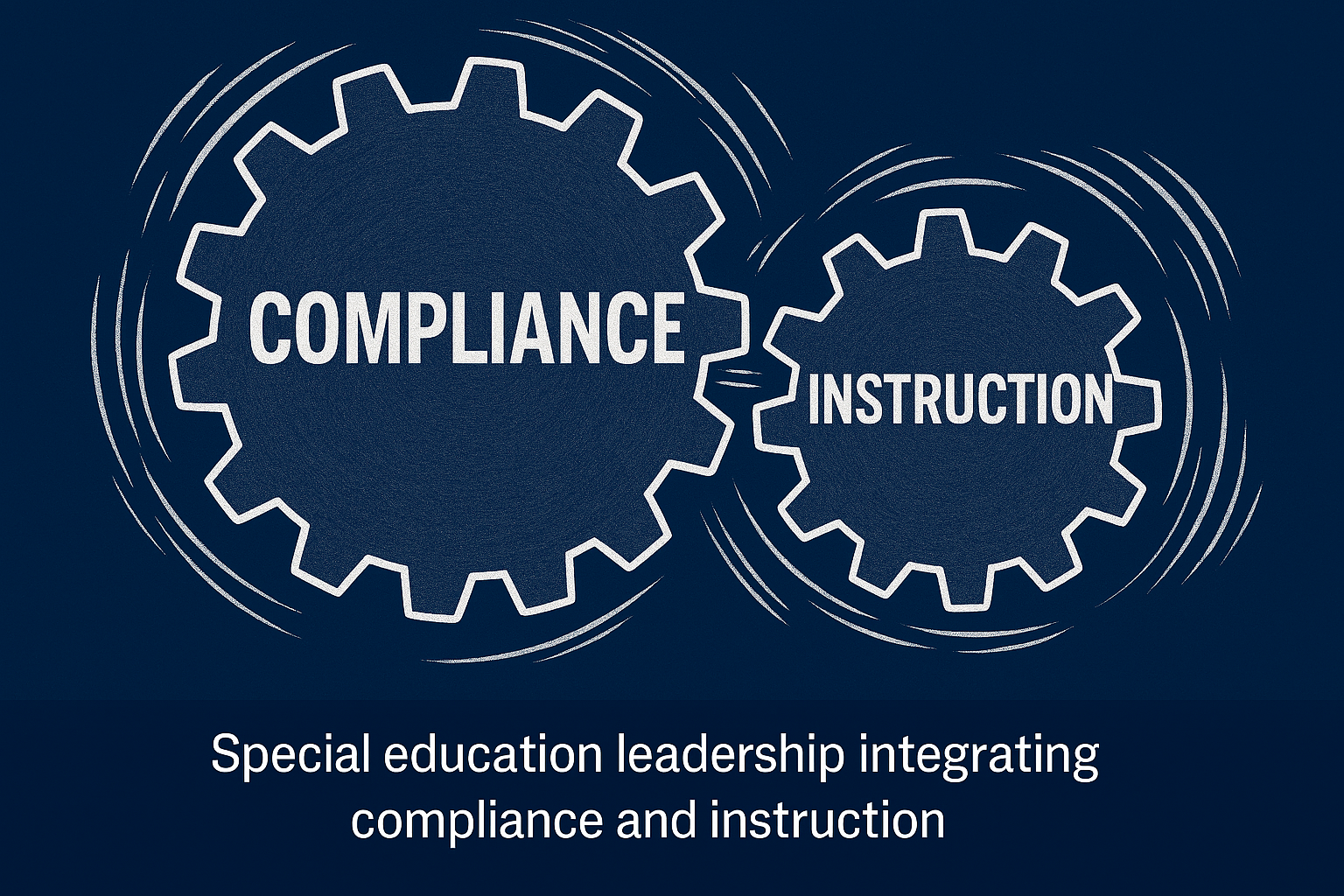
“In most school districts, special education and general education instruction operate as separate enterprises. Two departments. Two leaders. Two distinct conversations about students who, in reality, share the same classrooms and the same learning goals. This structural separation is not just an administrative inconvenience. It is a systems failure that quietly undermines our capacity to serve students well.”
As an executive director in special education, I have seen what happens when this fragmentation goes unaddressed. Capable teams exhaust themselves chasing compliance while the instructional experiences of students stagnate. Compliance becomes the highest goal rather than the foundation upon which good instruction is built. The result is a system that meets the letter of the law without ever realizing its spirit.
My core argument is straightforward. Compliance and instruction are not competing priorities. They are interdependent systems that, when integrated, allow leaders to deliver on the promise of meaningful education for every learner.
The GPS and the Driver

I think of compliance as a GPS. It provides the architecture, the routes that must exist, the checkpoints you need to hit. It is the legal and procedural infrastructure that ensures every student has access and protection. A good GPS gets you oriented. It removes ambiguity about where you are supposed to go.
But a GPS alone does not get you anywhere. You need a driver. That is instruction. The driver must be competent, well-informed, and capable of executing the route with skill and intention. No matter how precise the navigation system, an unprepared driver will never reach the destination safely.
This analogy clarifies a tension I see playing out in district after district. When compliance becomes the destination rather than the foundation, staff prioritize documentation over learning. The system becomes performative. When leaders claim to prioritize instruction but lack the structural commitment of compliance, the work becomes inconsistent and inequitable. Without the GPS, even the most skilled driver gets lost.
A Systems Problem Requires Systems Thinking
Peter Senge's work on learning organizations reminds us that systems are interconnected wholes. When you fragment a system into isolated parts, the parts may function, but the whole loses coherence. Districts that organize compliance and instruction as separate operations are doing exactly that. They are managing the parts while the whole drifts.
Senge teaches us that the structure of a system shapes its behavior. If your system is built around two siloed departments, do not be surprised when those departments operate in parallel rather than in partnership. Cross-functional projects help. Strategic plans that name shared priorities help. But until the structure itself is redesigned to reflect the integration of compliance and instruction, the underlying behavior will not change.
Structure Creates Culture
Bolman and Deal extend this thinking by reminding us that organizations create culture through the structures they build and the messages they reinforce. When districts house special education and general education in separate departments, with separate leaders who attend separate cabinet conversations, the structure itself sends a message. These are separate concerns. They serve different students. They require different expertise.
That message becomes culture. Staff internalizes it. Priorities compete rather than integrate. Conversations about curriculum design happen in one room while conversations about access and accommodations happen in another. Students with disabilities are served at the margins of decisions that should have included their needs from the start.
True instructional leadership requires leaders to confront this structural reality. It means redesigning who sits at which table, which conversations are integrated by default, and how decisions get made. It means ensuring that special education leadership, multilingual learner leadership, and general education curriculum leadership are not occasionally in conversation but permanently in partnership.
Universal Design for Learning Is Not a Special Education Strategy

This is where the work of Rose, Gravel, and others on Universal Design for Learning becomes essential. UDL is often miscategorized as a special education framework. It is not. It is a general education imperative, grounded in the science of learner variability, that ensures instruction is designed with all students in mind from day one.
When I served as an achievement coach, I worked with teachers across grade levels and content areas to embed UDL principles into Tier One instruction. The conversation was never about retrofitting lessons for students with disabilities. It was about designing instruction so that variability was anticipated and welcomed from the start. Multiple means of representation. Multiple means of action and expression. Multiple means of engagement. These are not accommodations. They are design principles.
This matters for the compliance and instruction conversation in a specific way. When special education leaders bring expertise in UDL and learner variability into instructional decision-making, they are not showing up as compliance officers. They are showing up as instructional architects. Their expertise belongs at the center of curriculum design, not at the margins.
High-Impact Teaching Is the Common Ground
John Hattie's research on visible learning offers another anchor. The teaching practices that move the needle most for students with disabilities are the same practices that accelerate learning for every student. Explicit instruction. Formative assessment. Feedback loops. Metacognitive strategies. These are not special education practices. They are evidence-based practices.
When compliance and instruction operate as one integrated system, these high-impact practices become non-negotiable for every classroom, not because they are mandated but because they are what the evidence supports. Compliance, in this framing, becomes the structural commitment to ensuring these practices happen consistently, equitably, and with fidelity across the system. It prevents drift. It ensures that the quality of instruction does not depend on which classroom a student happens to be assigned.
A Self-Assessment for Leadership Teams
If you lead a special education system or sit on a district leadership team, consider sitting with these questions alongside your colleagues. The goal is not to arrive at quick answers. The goal is to surface where your structure, culture, and practice may be reinforcing the very separation you are trying to dismantle.
Floor or ceiling. Are we using compliance as the floor of our work, the non-negotiable foundation upon which we build instructional excellence? Or have we allowed compliance to become the ceiling, the place where our ambition stops once the paperwork is done?
Conversations. When we talk about special education in our organization, are those conversations integrated into our instructional cabinet, or are they separated into compliance reviews and procedural meetings? Who is at the table when curriculum decisions are made?
Decisions. When we evaluate an instructional initiative, are we asking only whether it is compliant? Or are we asking whether it is compliant and whether it advances learning for every student, including those who require differentiated entry points?
Experience. Do our staff experience compliance as something that enables their instructional practice, or as something that competes with it? What in our messaging may be reinforcing the wrong narrative?
Structure. If a stranger reviewed our organizational structure tomorrow, what message would they receive about how we view the relationship between compliance and instruction? Would the structure itself communicate integration, or separation?
The Leadership Imperative
The districts that move the needle on outcomes for students with disabilities are not the ones with the most elaborate compliance systems. They are the ones where leaders have done the harder work of designing structures, cultures, and decision-making processes that make it impossible to separate compliance from instruction.
This is the work I am committed to as a leader and as someone preparing to enter doctoral study. It is work that requires intellectual rigor, structural courage, and a willingness to dismantle the silos that have defined our profession for too long. Compliance and instruction are not two lanes. They are one system. The sooner we lead as if that is true, the sooner our students will benefit.
Further Reading
Bolman, L. G., & Deal, T. E. Reframing Organizations: Artistry, Choice, and Leadership. Jossey-Bass.
Hattie, J. Visible Learning: A Synthesis of Over 800 Meta-Analyses Relating to Achievement. Routledge.
Rose, D. H., & Gravel, J. W. Universal Design for Learning. CAST Professional Publishing.
Senge, P. M. The Fifth Discipline: The Art and Practice of the Learning Organization. Doubleday.
About the Author
Orville Ingram is an executive director in special education and the founder of Ingram Education and Consulting, a leadership development and executive coaching practice serving educators and organizations committed to equity-driven instruction. His work focuses on the intersection of leadership, instructional design, and systems-level change.
For more blogs, always visit our website.