From Bottleneck to Bridge: 3 Signs You’re Micromanaging and How to Scale Through Trust

In the modern workplace, leadership is often misconstrued as being the most knowledgeable person in the room who oversees every moving part. However, research into organizational culture reveals a stark reality: while few leaders admit to being micromanagers, approximately 59 percent of employees report having worked for one at some point in their career. Micromanagement is not merely an annoying habit; it is one of the most damaging and morale-sapping ways to manage people, directly affecting productivity, employee retention, and even the physical health of staff members.
To move from being a manager who "does" to a leader who "empowers," you must embrace the Delegation & Trust Building pillar. This shift requires moving away from transactional management—where work is only done for rewards—and toward a relationship-based approach that fosters autonomy and growth.
--------------------------------------------------------------------------------

Here are three major signs that you are micromanaging your team, along with a roadmap for how to delegate effectively and rebuild trust.
Sign 1: You Have Become the Ultimate Bottleneck
The most obvious sign of micromanagement is when every decision, email, or minor task must pass across your desk for "one final look". Micromanagers often closely guard information, which makes it virtually impossible for team members to take the lead on tasks because they lack the necessary context.
If you find that projects are constantly stalled because your team is waiting for your review, you have become a bottleneck. This often happens because leaders believe it is "just easier to do it myself" or because they have high expectations that they don't believe others can meet. This behavior creates a culture of dependency, where your team is afraid to take initiative because they know you will likely redo the work anyway. Consequently, you become overloaded with other people's work, which causes you to fail at your own high-level strategic responsibilities.
Sign 2: You Focus on the “How” Instead of the “What”
A hallmark of micromanagement is providing instructions that are so detailed they leave no room for innovation. If you find yourself correcting minute details rather than focusing on the end result, you are nitpicking rather than leading.
Effective delegation requires you to tell your team what needs to be achieved and why you chose them for the task, then giving them the authority to decide how to produce those results. When you obsess over the specific method, you signal to your team that you don’t trust their expertise or their ability to solve problems creatively. This hyper-focus on minutiae makes employees feel they are working under a microscope, causing them to second-guess their own competence.
Sign 3: You Require Constant, Detailed Status Updates
While accountability is essential, an obsession with constant updates is a major red flag. If your team spends more time documenting what they are doing than actually doing the work, productivity suffers. This constant need for justification makes employees feel untrusted and watched.
In a high-trust environment, leaders agree upfront on a schedule of checkpoints for reviewing progress. This allows you to maintain control and provide coaching without stifling the team's day-to-day autonomy. If you cannot let an hour go by without checking in, you are not managing a project; you are managing a person’s every movement.
--------------------------------------------------------------------------------

How to Delegate and Build Trust Instead
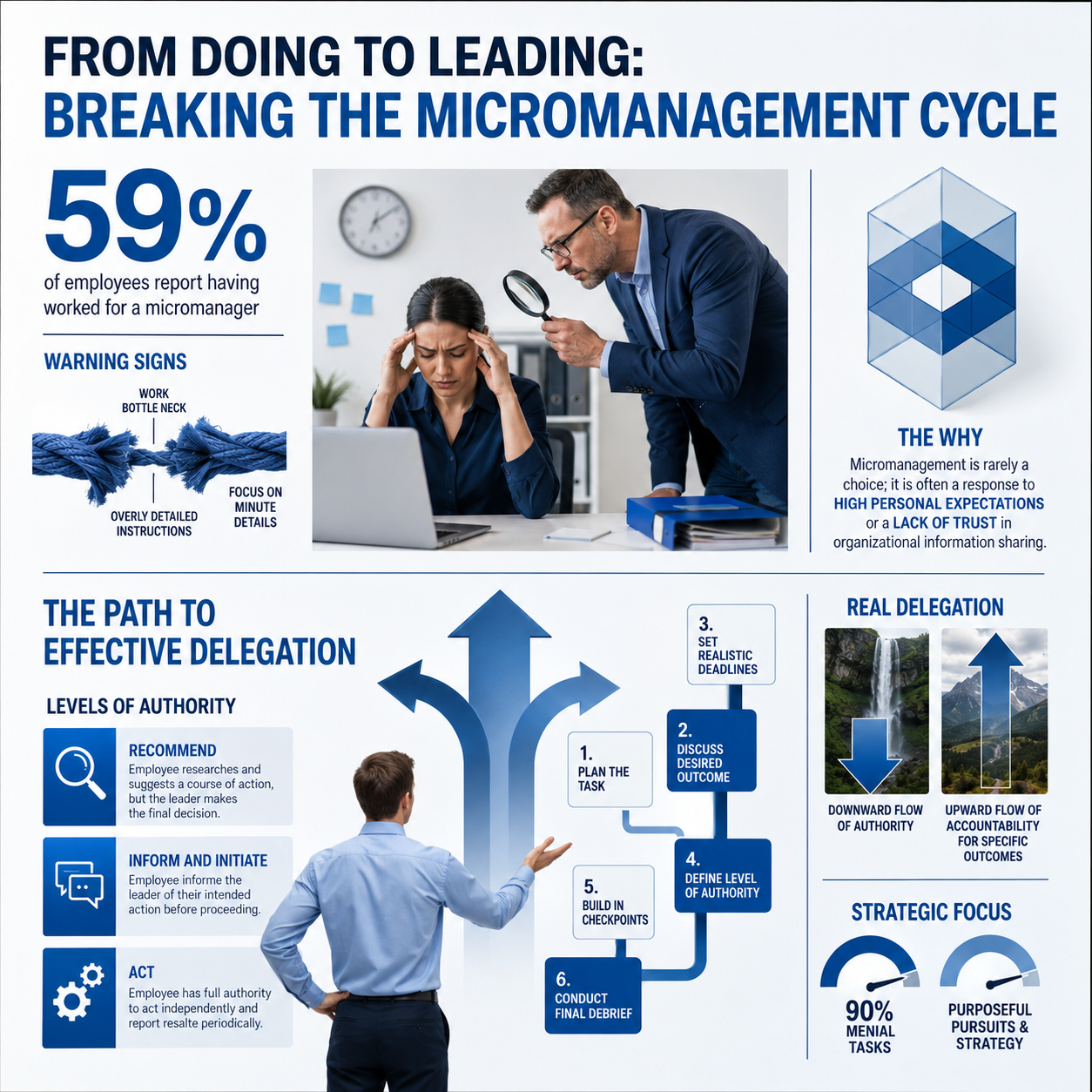
Mastering delegation is a skill that can be learned and developed. It is not about abdicating responsibility—after all, the "buck stops with you"—but about building your team's capabilities.
1. Know WHAT to Delegate
Not every task should be handed off. Focus on delegating repetitive tasks that follow a set process, expertise-based tasks that align with a team member’s strengths, and development opportunities that allow a staff member to grow. This frees you to focus on high-level strategic initiatives.
2. Define the Level of Authority
One of the best ways to build trust is to be explicit about how much power you are handing over. There are generally three levels of authority you can grant:
Recommend: The employee researches and provides a course of action, but you make the final call.
Inform and Initiate: The employee informs you of their plan before taking action.
Act: The employee has full authority to act independently and report results periodically.
3. Practice "Humble Leadership"
Move away from transactional management and toward leadership that focuses on personal relationships. Ask your team how they want to be managed and seek their input on projects. This establishes autonomy and shows that you value their expertise.
4. Share Information Openly
To delegate effectively, you must share privileged information as regularly and comprehensively as possible. Brief your team often and have them brief each other. When a team is fully informed, they are better equipped to act independently, which solves "at least half the problem" of delegation.
5. The Power of Positive Feedback
Research suggests that the ratio of positive to negative statements is a key predictor of performance. Use "best-self feedback" to focus on an employee's potential rather than just correcting their mistakes. When team members feel appreciated, they are more likely to take the initiative and work for the common good of the organization.
--------------------------------------------------------------------------------
Sources
Zoe Mackey, "3 Big Signs That You May be Micromanaging" - Berrett-Koehler Publishers Blog.
Aimée Brougham-Chandler, "7 signs you're dealing with a micromanager" - Breathe HR.
Matt Allen, "8 Steps for Rebuilding Trust After a Conflict" - TrustBuilder® Framework.
Radha Mehrotra, "Delegation of Authority: How to Delegate Work in 6 Steps" - BetterUp.
Gavin Brown, "Effective Delegation Techniques for New Managers" - Niagara Institute.
Mind Tools, "Successful Delegation" & "Avoiding Micromanagement".
Coursera Staff, "Micromanagement Meaning and How to Deal With It".
Ken Blanchard, "Situational Leadership II".
DB Coaching & Consulting, "Delegation Workshop".
--------------------------------------------------------------------------------
Call to Action
Are you ready to stop being the bottleneck and start being a leader? Pick one task today that you usually handle yourself and delegate it using the "Act" level of authority. Set a checkpoint for next week to review the results, not the process.
Empower your team, free your schedule, and watch your organization thrive.
Want More Blogs and Leadership Content?
Join our Facebook group, Rise to Lead, for exclusive access to insightful blogs and valuable leadership content.
👉 Click here to join Rise to Lead! >>>> bit.ly/RISETOLEADCOMMUNITY
Elevate your leadership skills with us today!